When a decayed baby tooth needs to be saved — painlessly†
Pulp therapy — sometimes called a "children's root canal" — is a treatment to save a baby tooth when decay has gone very deep and reached the soft centre (called the pulp) of the tooth.
Many parents ask: "Why save a baby tooth? Won't it fall on its own?" The answer is very important: baby teeth act as space-holders for the permanent teeth growing below. If a baby tooth is removed too early, the surrounding teeth drift into the gap — and the permanent tooth has no space to grow straight.
Pulp therapy saves the tooth, keeps the space, and avoids braces or space-maintainer appliances later. And when done properly, it is completely painless†.
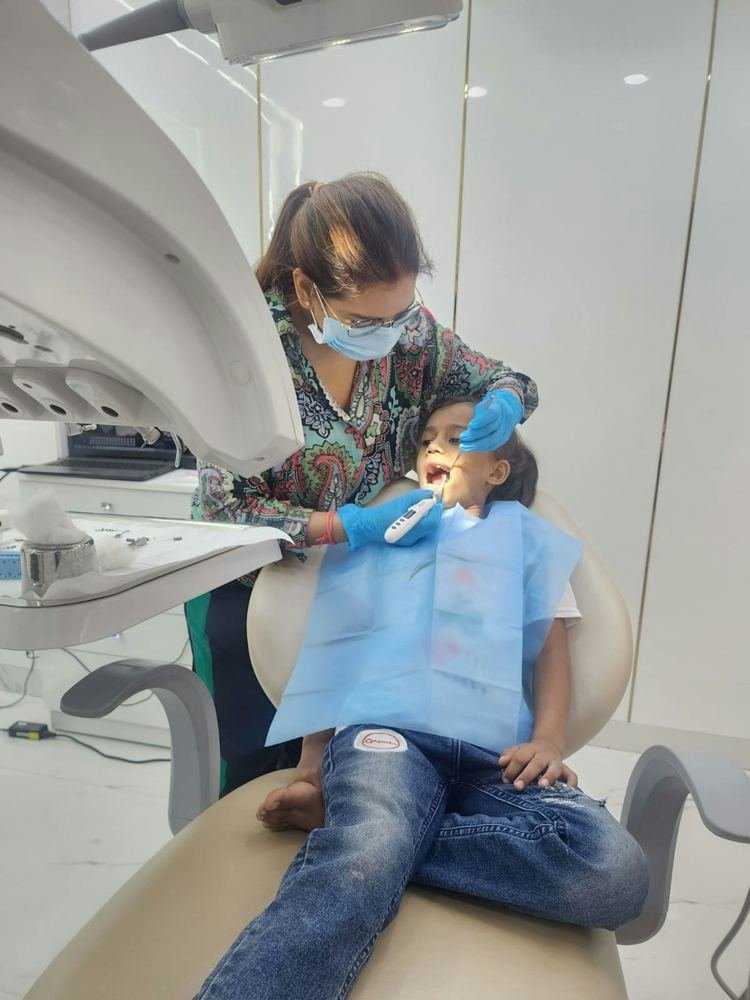
We explain every step to your child before doing it — so there are no surprises and no fear.
A gel is applied first so the child does not feel the injection. Local anaesthesia is given — the child feels pressure, but no pain. We wait until the tooth is fully numb before starting.
The soft infected tissue inside the tooth is gently removed. The child feels nothing — the area is completely numb.
The inside of the tooth is cleaned thoroughly and a medicated material is placed — this stops any remaining infection and helps the tooth heal.
The tooth is sealed completely so nothing can get inside again.
Almost always, a stainless steel cap or tooth-coloured crown is placed on top to protect the treated tooth until it naturally falls out.
No — when done correctly with proper anaesthesia, pulp therapy is not painful. We use topical gel before the injection so the child does not feel the needle. Most children are surprised at how comfortable it is.
Early removal of baby teeth causes surrounding teeth to drift, blocking space for permanent teeth. This often leads to crooked permanent teeth and expensive orthodontic treatment later. Saving the tooth is almost always the better option.
Typically 30–60 minutes depending on which tooth is being treated. We never rush. The child is kept comfortable throughout.
Yes, almost always. A cap (crown) is placed on the treated tooth to protect it — a treated tooth becomes slightly brittle, and the cap prevents it from breaking. This is standard practice, not an add-on.
Call or WhatsApp us to book. Mon–Fri, 4 PM – 9 PM (Sat by appointment).
One clinic, one trusted team — a kids' dental home in Dombivli East.
Saroj CHS, Manpada Cross Road, Near ICON Hospital, Dombivli East – 421201
* In a review of 22 clinical trials, fluoride varnish reduced tooth decay by about 37% in baby teeth and 43% in permanent teeth (Marinho VCC et al., Cochrane Database of Systematic Reviews, 2013, doi:10.1002/14651858.CD002279.pub2). Results vary with each child's diet, brushing and cavity risk.
† We use comfort-first techniques, numbing gel and local anaesthesia when needed, so most children feel little or no discomfort. Every child is different; we explain what to expect before any treatment.
 Mon–Fri 4 PM – 9 PM · Sat by appt
 Manpada Cross Road, Dombivli East
 97689 58636
 WhatsApp


 Book Appointment